The Easter Bunny Came Again the Easter Bunny Came
| A 1907 postcard featuring the Easter Bunny | |
| Group | Legendary creature |
|---|---|
| Sub group | Animal |
| Other name(s) | Easter Rabbit, Easter Hare |
| Country | Federal republic of germany |

The Easter Bunny (also called the Easter Rabbit or Easter Hare) is a folkloric figure and symbol of Easter, depicted as a rabbit—sometimes dressed with clothes—bringing Easter eggs. Originating among German Lutherans, the "Easter Hare" originally played the function of a guess, evaluating whether children were adept or disobedient in behavior at the starting time of the flavor of Eastertide,[1] similar to the "naughty or nice" listing made past Santa Claus. As part of the legend, the creature carries colored eggs in its basket, as well every bit candy, and sometimes toys, to the homes of children. As such, the Easter Bunny again shows similarities to Santa (or the Christkind) and Christmas by bringing gifts to children on the night before a holiday. The custom was showtime[2] [ unreliable source? ] mentioned in Georg Franck von Franckenau's De ovis paschalibus [iii] ('About Easter eggs') in 1682, referring to a High german tradition of an Easter Hare bringing eggs for the children.
Symbols
Rabbits and hares

The hare was a popular motif in medieval church art. In aboriginal times, it was widely believed (as past Pliny, Plutarch, Philostratus, and Aelian) that the hare was a hermaphrodite.[4] [v] [6] The idea that a hare could reproduce without loss of virginity led to an association with the Virgin Mary, with hares sometimes occurring in illuminated manuscripts and Northern European paintings of the Virgin and Christ Kid. It may too take been associated with the Holy Trinity, as in the 3 hares motif.[4] [7]
Eggs
Eggs have been used as fertility symbols since antiquity.[8] Eggs became a symbol in Christianity associated with rebirth as early equally the 1st century AD, via the iconography of the Phoenix egg, and they became associated with Easter specifically in medieval Europe, when eating them was prohibited during the fast of Lent. A mutual exercise in England at that fourth dimension was for children to go door-to-door begging for eggs on the Sat before Lent began. People handed out eggs as special treats for children prior to their fast.[9]
Every bit a special dish, eggs would probably accept been decorated every bit part of the Easter celebrations. Afterwards, High german Protestants retained the custom of eating colored eggs for Easter, though they did not go on the tradition of fasting.[ten] Eggs boiled with some flowers change their color, bringing the spring into the homes, and some over fourth dimension added the custom of decorating the eggs.[xi] Many Christians of the Eastern Orthodox Church to this twenty-four hours typically dye their Easter eggs cherry,[12] the color of blood, in recognition of the blood of the sacrificed Christ (and, of the renewal of life in springtime). Some also use the color light-green, in honour of the new leaf emerging later the long-dead time of winter. The Ukrainian art of decorating eggs for Easter, known every bit pysanky, dates to ancient, pre-Christian times. Similar variants of this form of artwork are seen amongst other eastern and cardinal European cultures.[13]
The idea of an egg-giving hare went to the U.S. in the 18th century. Protestant German immigrants in the Pennsylvania Dutch area told their children about the " Osterhase " (sometimes spelled " Oschter Haws " [14]). Hase means "hare", not rabbit, and in Northwest European sociology the "Easter Bunny" indeed is a hare. According to the fable, simply good children received gifts of colored eggs in the nests that they made in their caps and bonnets earlier Easter.[15]
Gallery
-
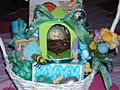
Marshmallow bunnies and candy eggs in an Easter handbasket
-

A existent live bunny with busy Easter eggs
-

Chocolate Easter bunnies
-

Chocolate Easter Bunny molds from Alsace Musée du pain d'épices
Alleged association with Ēostre
In a publication from 1874 High german philologist Adolf Holtzmann stated "The Easter Hare is unintelligible to me, simply probably the hare was the sacred animal of Ostara".[16] The connection between Eastern and that goddess had been made past Jacob Grimm in his 1835 Deutsche Mythologie.[17] This proposed association was repeated past other authors including Charles Isaac Elton[18] and Charles J. Billson.[19] In 1961 Christina Hole wrote, "The hare was the sacred creature of Eastre (or Ēostre), a Saxon goddess of Bound and of the dawn."[twenty] [ page needed ] The belief that Ēostre had a hare companion who became the Easter Bunny was popularized when information technology was presented equally fact in the BBC documentary Shadow of the Hare (1993).[21]
The Oxford Dictionary of English Folklore however states "... at that place is no shred of evidence" that hares were sacred to Ēostre, noting that Bede does non acquaintance her with any animal.[22] [ page needed ]
See also
- Easter
- Domestic and pet rabbits
- Easter Bilby
- Mad every bit a March hare
- Rabbits and hares in art
- Rabbits in civilisation and literature
- "The Goose That Laid the Golden Eggs"
References
- ^ Cantankerous, Gary (2004). Wondrous Innocence and Modern American Children'south Culture. Oxford University Press. ISBN978-0195348132.
- ^ Easter Bunny – What Does He Accept To Do With Easter?, occultcenter.com
- ^ Franck von Franckenau, Georg (1682). Disputatione ordinaria disquirens de ovis paschalibus / von Oster-Eyern. Satyrae Medicae. Vol. XVIII. Heidelberg. p. 6. Retrieved 18 July 2013.
- ^ a b Chapman, Chris (2004). "What does the Symbol Hateful?". Three Hares Project . Retrieved 20 April 2014.
- ^ Marta Powell Harley (1985). "Rosalind, the hare, and the hyena in Shakespeare's As Y'all Like Information technology". Shakespeare Quarterly. 36 (three): 335–337. doi:x.2307/2869713. JSTOR 2869713.
- ^ "Sir Thomas Browne (1646; 6th ed., 1672) Pseudodoxia Epidemica III:xvii (pp. 162–166)".
- ^ "Three Hares every bit representation of the Trinity". Threehares.blogspot.com. 2006-02-25. Retrieved 2010-06-29 .
- ^ Heller, Steven (Apr 2014). "Seeing Rabbits". Academic Search Complete. Vol. 68, no. 2.
- ^ D'Costa, Krystal. "Beyond Ishtar: The Tradition of Eggs at Easter". Scientific American. Archived from the original on 28 March 2018. Retrieved 28 March 2018.
- ^ Shrove Tuesday Pancakes! by Bridget Haggerty – Irish Civilisation & Community, Earth Cultures European, paragraph 5 line 2 refers to the Cosmic custom of abstaining from eggs during Lent. Accessed 3/1/08
- ^ Snodgrass, Lucie L. (March 2005). "DYED IN Tradition". Academic Search Consummate. No. 329. Vegetarian Times.
- ^ How To Dye Ruby-red Eggs with Onion Skins for Greek Easter past Nancy Gaifyllia from Your Guide to Greek Food on Nearly.Com Accessed April nine, 2008
- ^ Hallett, Vicky (March 31, 2003). "Egg-cellent art". Academic Search Complete. Vol. 134, no. ten. U.S. News & Globe Report.
- ^ "Gruß vom Osterhasen: Oschter Haws Song". Germanworldonline.com. 2011-04-23. Retrieved 2013-03-31 .
- ^ Easter Symbols Archived 2008-03-12 at the Wayback Machine from Lutheran Hour Ministries. Accessed 2/28/08
- ^ Holtzmann, Adolf (1874). Deutsche Mythologie. Leipzig: B. G. Teubner. p. 141.
- ^ Grimm, Jacob (1835). Deutsche Mythologie. Göttingen: Dietrichsche Buchhandlung. pp. 181–182.
- ^ Elton, Charles Isaac (1882). Origins of English language History. London: Bernard Quaritch. pp. 407–408.
- ^ Charles J Billson (1892). Folk-Lore vol. three outcome 4
- ^ Christina Hole (1961). Easter and its Customs
- ^ Attenborough, Sir David (Presenter) (Apr 12, 1993). Wildlife on One Easter Special Shadow of the Hare (Television receiver). United Kingdom: BBC.
- ^ Jacqueline Simpson and Stephen Roud (2000). A Dictionary of English Folklore
External links
- Charles J. Billson. "The Easter Hare". Folk-Lore. Vol. three, No. 4 (December 1892).
- On the Bunny Trail: In Search of the Easter Bunny, Stephen Winick, Folklife Today, March 22, 2016
- Osterfuchs [de] (Easter Fox) (in German)
Source: https://en.wikipedia.org/wiki/Easter_Bunny
0 Response to "The Easter Bunny Came Again the Easter Bunny Came"
Post a Comment